Did Japan Enact an Anti-Islam Law Banning Mosques and Burqas? No Such Law Exists. [FACT CHECK]
![Did Japan Enact an Anti-Islam Law Banning Mosques and Burqas? No Such Law Exists. [FACT CHECK]](https://storage.ghost.io/c/93/3f/933fd1fd-ac61-4d64-bfe3-29efbe11e914/content/images/size/w1200/2026/03/------Top------------------------------------2025---6---18-----------70-.jpg)
Claims that Japan enacted an "anti-Islam law" banning mosque construction and the wearing of burqas spread in English and Spanish — but they are false. Japan's constitution guarantees freedom of religion, and no law prohibiting religious practice exists. The Agency for Cultural Affairs' Religious Affairs Division, which oversees religious policy, has also denied the claims.
※これは「日本が反イスラム法を制定し、モスクやブルカを禁止? そのような法律はない【ファクトチェック】」の英語版です(This is the English version of the article mentioned above)。
CLAIM UNDER REVIEW
The Viral Claim
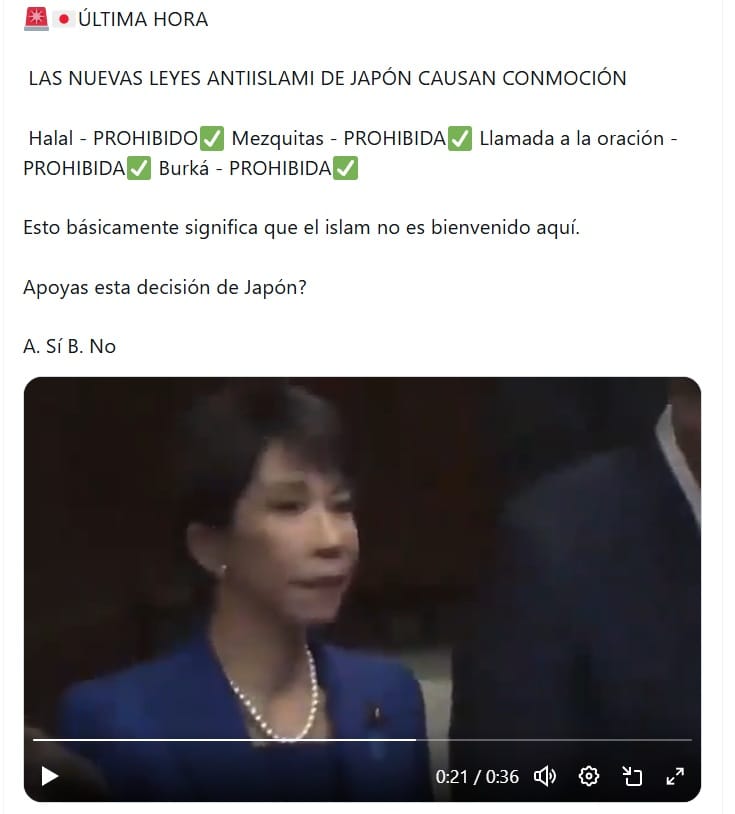
On March 8, 2026, a post written in Spanish spread on X, reading: "BREAKING — Japan's new anti-Islam law shocks the world. Halal - BANNED ✅ Mosques - BANNED ✅ Call to prayer - BANNED ✅ Burqa - BANNED ✅ This basically means Islam is not welcome here. Do you support Japan's decision?"
Why We're Fact-Checking This
Similar posts have also spread in English (example 1, 2). While some responses called the claims false, many comments expressed agreement, including remarks such as "If only we had the courage like them to contain Islam" and "Japanese culture is one of the greatest on the planet . Why should it be thinned out by barbaric cultures."
VERIFICATION
The Attached Video Is Unrelated to the Claim
The viral posts include an attached 36-second video. The footage shows then-Speaker of the House of Representatives Fukushiro Nukaga declaring the dissolution of the lower house under Article 7 of the Constitution of Japan on January 23, 2026. followed by three rounds of 'Banzai’ and Prime Minister Sanae Takaichi bowing to the chamber.
The video has no connection whatsoever to the claim that Japan enacted an anti-Islam law.
Freedom of Religion Is Constitutionally Protected
Article 20 of the Constitution of Japan guarantees freedom of religion as follows:
"Freedom of religion is guaranteed to all. No religious organization shall receive any privileges from the State, nor exercise any political authority.
2. No person shall be compelled to take part in any religious act, celebration, rite or practice.
3. The State and its organs shall refrain from religious education or any other religious activity."
(Source: House of Representatives of Japan, "The Constitution of Japan")
Therefore, if the Japanese government were to enact an “anti-Islam law,” it would be inconsistent with the Constitution of Japan..
Government's Religious Affairs Division Denied the Claims
The Religious Affairs Division of the Agency for Cultural Affairs, which oversees Japan's religious policy, responded to an inquiry from the Japan Fact-Check Center (JFC) as follows:
"Apart from cases involving violations of the Building Standards Act and similar regulations, we are not aware of any cases in which mosque construction has been halted. Additionally, given that freedom of religion exists, the Religious Affairs Division does not prohibit any religious activities. We take the position of neither instructing nor discouraging individual religious practices. Regarding the prohibition of wearing burqas or the call to prayer, I have at least never heard of such things being prohibited as national policy."
When asked whether any legislation to ban mosque construction or the wearing of burqas was under consideration, the official replied: "To my knowledge, no such bill exists".
Local Opposition Movements Do Exist
It is true that opposition movements against mosque construction have arisen in various parts of Japan.
The petition platform “Voice” hosts campaigns calling for the halting of mosque construction, stricter enforcement against street prayers, and the prohibition of welfare benefits for foreign nationals.
One petition titled "Calling for the Cancellation of the Mosque Construction Plan at 3344-1 Miyahara, Fujisawa City" states in its organizer's description: "We have serious concerns about the current situation, in which the project is proceeding without the understanding or consent of local residents on issues directly affecting daily life, including traffic conditions, crime prevention and safety, and the impact on the surrounding living environment."
However, these are protests by some residents. No law regulating Islam has been enacted or deliberated upon.
VERDICT:FALSE
Claims suggesting that Japan enacted a law banning mosque construction and the wearing of burqas spread in English and Spanish. Japan's constitution guarantees freedom of religion, and no law regulating Islam exists. The Religious Affairs Division of the Agency for Cultural Affairs confirmed that it has "never heard of such things being prohibited as national policy." The claim is therefore rated FALSE.
Fact-checker’s Note
This fact-check was conducted in response to an inquiry from the Spanish fact-checking organization VERIFICAT. We would like to express our gratitude to VERIFICAT for bringing this to our attention.
We remain committed to expanding our verification efforts in collaboration with related organizations abroad.
SOURCES
House of Representatives of Japan. "The Constitution of Japan." https://www.shugiin.go.jp/internet/itdb_annai.nsf/html/statics/shiryo/dl-constitution.htm (Accessed March 12, 2026).
Petition platform Voice. "Calling for the Cancellation of the Mosque Construction Plan at 3344-1 Miyahara, Fujisawa City." https://voice.charity/events/10462 (Accessed March 12, 2026).
Petition platform Voice. "Calling for Opposition to Mosque Construction, Stricter Enforcement Against Street Prayers, and Prohibition of Welfare Benefits for Foreign Nationals." https://voice.charity/events/11749 (Accessed March 12, 2026).
Verified by: Ayako Nezu
Edited by: Daisuke Furuta, Kamome Fujimori
判定基準などはJFCファクトチェック指針をご参照ください。
毎週、ファクトチェック情報をまとめて届けるニュースレター登録(無料)は、上のボタンから。また、QRコード(またはこのリンク)からLINEでJFCをフォローし、気になる情報を質問すると、AIが関連性の高いJFC記事をお届けします。詳しくはこちら。